
Decision guide
When a Crypto Tax Estimate Needs Better Transaction Data
When a crypto estimate feels unstable, the problem is often the transaction data rather than the tax rate. The decision is whether the current records can support planning—or whether lot-level reconstruction must happen first.
9 minute read · 2026 U.S. federal tax
Test the decision
Aggregate short- and long-term results
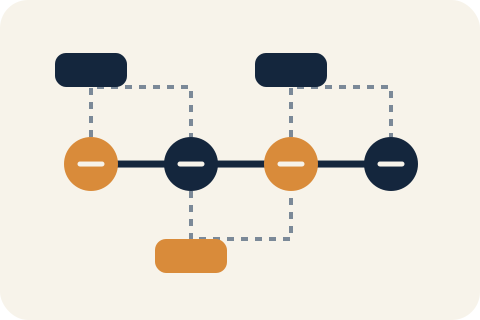
- 1Identify disposition
- 2Reconcile basis, value, fees, dates
- 3Aggregate short- and long-term results
How far can this estimate carry the decision?
Follow the path that matches the quality and complexity of the available facts.
- Path 1
Yes—inputs are documented and the scenario stays inside scope
Estimate is probably enoughUse it for a bounded planning comparison.
- Path 2
A material amount, date, classification, or eligibility fact is uncertain
Verify more dataResolve the fact, then rerun the same scenario.
- Path 3
The issue is disputed, specialized, or outside the model
Consider professional reviewUse current forms, instructions, or advice based on the full facts.
Compare record quality before comparing tax outcomes
A high-confidence scenario uses exchange exports, wallet records, timestamps, fees, and supported basis. A provisional scenario may use documented valuation assumptions. A balance-only estimate is not enough because it cannot identify dispositions or holding periods.
Mark uncertain rows rather than silently mixing estimated and confirmed amounts. The calculator itself has no confidence score.
- Reconciled disposition and lot records
- Documented provisional valuation or basis
- Incomplete balance-level information requiring reconstruction
Basis and dates are the first numbers to challenge
Missing basis can overstate gain; unsupported basis can understate it. One date can move a result between ordinary short-term treatment and the preferential long-term stack.
Fees and fair market value matter for swaps and spending, while capital carryovers require the filed-return worksheet rather than an exchange dashboard.
Three scenarios worth separating
Each column changes a distinct planning assumption so the cause of movement stays visible.
Reconciled records
- Change
- Complete lot and transaction data
- Use
- Create the planning estimate
Provisional basis/value
- Change
- Document the uncertain assumption
- Use
- Show sensitivity only
Incomplete transaction set
- Change
- Balance-level data only
- Use
- Stop and reconstruct records
Escalate when the event is not a straightforward capital disposition
Mining, staking, compensation, lending, token migrations, wrapped assets, gifts, donations, losses, foreign reporting, business dealing, or disputed token classification can require additional income and basis analysis.
Use current IRS digital-asset guidance, Form 8949 instructions, and professional review when records span platforms or material events do not fit the calculator’s four disposition categories.
Data-readiness signals
Use the three lanes to decide whether to compare, verify, or widen the review.
Ready to compare
- Disposition inventory is complete
- Basis is matched to disposed units
- Dates, values, and fees reconcile
Verify first
- Self-custody and exchange records disagree
- A swap lacks a defensible value
- A carryover is unconfirmed
Widen the review
- Mining, staking, lending, migration, gifts, or losses
- Token classification or foreign reporting is material
Before you use the estimate
- Reconcile exchange exports with self-custody wallets.
- Document fair market value and fees for noncash transactions.
- Match basis to the disposed units.
- Identify non-capital income and special events separately.
Where this estimate stops
- The tool cannot certify transaction completeness or data provenance.
- It does not choose tax lots or decide the treatment of complex digital-asset events.
Sources and references
Only the primary federal sources used for the rules discussed in this guide are listed here.
- Digital assets
Internal Revenue Service · The federal treatment and reporting context for digital-asset transactions.
- Frequently asked questions on digital asset transactions
Internal Revenue Service · Sale, exchange, transfer, basis, and fair-market-value distinctions discussed in the guide.
- Topic No. 409, Capital Gains and Losses
Internal Revenue Service · General capital gain and loss character, netting, the annual capital-loss deduction, and carryover treatment.
- Revenue Procedure 2025-32
Internal Revenue Service · The inflation-adjusted 2026 ordinary brackets, standard deductions, preferential-rate thresholds, and other indexed amounts used by the applicable calculation.
TaxArith provides illustrative 2026 U.S. federal tax estimates for general information. It is not tax, legal, financial, or investment advice and does not prepare or file a return. Results depend on the accuracy and completeness of the submitted facts.