
Fundamentals
CTC, ODC, and ACTC: Three Limits in One Estimate
A dependent can pass one part of a credit analysis and still produce less than the headline amount. TaxArith separates dependent screening, the combined MAGI phaseout, available tax liability, and refundable ACTC capacity because each can be the binding limit.
11 minute read · 2026 U.S. federal tax
See the mechanism
Screen each dependent
- 1Screen each dependent
- 2Apply combined MAGI phaseout
- 3Split nonrefundable and ACTC use
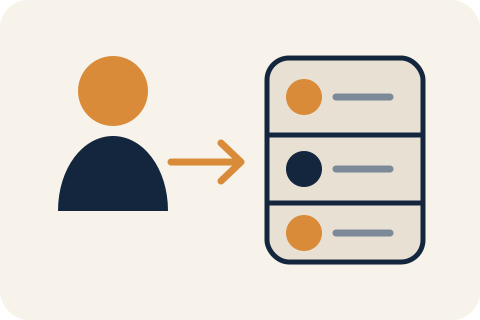
Screen each selected dependent before adding potential credit
A row identified as a qualifying child for CTC/ACTC is checked against submitted age, work-eligible SSN, U.S. status, dependency confirmations, taxpayer identification, competing-claim, and custody-review facts. An ODC row uses its own submitted TIN and category facts.
The tool trusts confirmations; it does not resolve residency, relationship, support, joint-return, tie-breaker, divorced-parent, or identification disputes.
Eligibility is followed by three separate limits
Production values show potential CTC/ODC, phaseout, available liability, nonrefundable use, and modeled ACTC.
Potential CTC
Potential ODC
After MAGI phaseout
Nonrefundable use
Refundable ACTC
Combine potential CTC and ODC before the MAGI phaseout
Eligible CTC children and ODC dependents create separate potential amounts under the project’s 2026 constants. The combined amount then faces the filing-status MAGI threshold.
Excess MAGI is rounded up in $1,000 units for the modeled $50-per-unit reduction. A tiny amount over the threshold can therefore reduce the credit by a full $50.
The same potential credit can meet different limits
Two families can each have one screened CTC child and the same potential amount. One may use it against available tax liability, while another with lower liability may depend on ACTC capacity. The dependent count alone does not determine the modeled benefit.
What changes the estimate most
Prioritize the inputs that can move this model before refining smaller details.
Dependent eligibility facts
High
Determine whether potential CTC or ODC enters the model.
MAGI
High
Controls the combined phaseout calculation.
Tax liability and earned income
High
Limit nonrefundable use and ACTC capacity.
Nonrefundable use stops at available tax liability
The calculator estimates federal tax before credits from taxable ordinary income, qualified dividends, and net long-term gain, then subtracts other nonrefundable credits to find liability available for CTC and ODC.
The nonrefundable dependent credit cannot reduce that available amount below zero. Unused credit is not automatically refundable.
ACTC has a separate earned-income and per-child capacity
For eligible CTC children, the model applies its 2026 earned-income threshold, 15% formula, refundable per-child cap, unused-credit limit, and submitted Form 2555 and identification facts. The alternative method is used only when explicitly selected with its required payroll-tax inputs.
ODC does not become ACTC. The combined benefit is nonrefundable CTC/ODC plus modeled ACTC, with any remainder shown as unavailable in this estimate.
The calculation boundary
The left side enters this model; the right side still requires another calculation or review.
Inside the boundary
- Submitted CTC/ODC screening facts
- 2026 MAGI phaseout
- Tax-liability limit and supported ACTC methods
Outside the boundary
- Legal dependent determination
- Custody/tie-breaker resolution
- Other family credits, filing, state tax
Before you use the estimate
- Classify each dependent as CTC, ODC, or not evaluated.
- Confirm identification and dependency facts outside the tool.
- Use MAGI—not taxable income—for phaseout.
- Keep other nonrefundable credits and earned income accurate.
Where this estimate stops
- No legal dependent determination, tie-breaker, custody, residency, support, identification, Form 2555, or alternative-method advice.
- The available 2026 Schedule 8812 was draft when reviewed and should be checked against the final version.
Sources and references
Only the primary federal sources used for the rules discussed in this guide are listed here.
- Revenue Procedure 2025-32
Internal Revenue Service · The inflation-adjusted 2026 ordinary brackets, standard deductions, preferential-rate thresholds, and other indexed amounts used by the applicable calculation.
- Child Tax Credit
Internal Revenue Service · Current federal CTC, ODC, identification, eligibility, and refundable-credit context.
- 2026 Schedule 8812
Internal Revenue Service · Draft—verify the final version before filing. The available 2026 dependent-credit and ACTC calculation structure; it was draft when reviewed.
TaxArith provides illustrative 2026 U.S. federal tax estimates for general information. It is not tax, legal, financial, or investment advice and does not prepare or file a return. Results depend on the accuracy and completeness of the submitted facts.