
Worked example
A Tax-Bracket Walkthrough for an $85,000 Single Filer
Jordan, a fictional single filer, expects $85,000 of ordinary income in 2026 and has already identified $3,000 of pre-tax adjustments. Jordan wants to understand the difference between being in a bracket and paying that rate on every dollar. This is an illustrative 2026 scenario, not personal tax advice.
7 minute read · 2026 U.S. federal tax
Follow the numbers
Fill bracket layers
- 1Build taxable income
- 2Fill bracket layers
- 3Read marginal and effective rates
The planning question behind the numbers
Jordan, a fictional single filer, expects $85,000 of ordinary income in 2026 and has already identified $3,000 of pre-tax adjustments.
Jordan wants to understand the difference between being in a bracket and paying that rate on every dollar. The filing-status context is Single, and every tax value uses the 2026 production calculation.
Scenario profile
Jordan wants to understand the difference between being in a bracket and paying that rate on every dollar.
Jordan, a fictional single filer, expects $85,000 of ordinary income in 2026 and has already identified $3,000 of pre-tax adjustments.
Single
Prepared inputs, grouped by role
Tax context
- 2026 tax year
- Single filing status
Income path
- $85,000 annual income
- $3,000 pre-tax adjustments
- 2026 basic standard deduction
Inputs the fictional taxpayer has prepared
The scenario uses the same inputs accepted by the calculator. No deduction, credit, basis amount, or eligibility conclusion is created inside the example.
- 2026 tax year
- $85,000 annual income
- $3,000 pre-tax adjustments
- 2026 basic standard deduction
- Single filing status
Follow the calculation from input to result
TaxArith passes the fixture through calculateTaxableIncome + calculateProgressiveTax. The values below use the site’s production formatting.
Production calculation journey
Values are generated by calculateTaxableIncome + calculateProgressiveTax.
calculateTaxableIncome + calculateProgressiveTax
- 1. Income after adjustments$82,000.00
- 2. Basic standard deduction$16,100.00
- 3. Taxable income$65,900.00
- 4. Amount in marginal bracket$15,500.00
- 5. Effective rate on taxable income13.98%
- 6. Estimated federal income tax$9,210.00
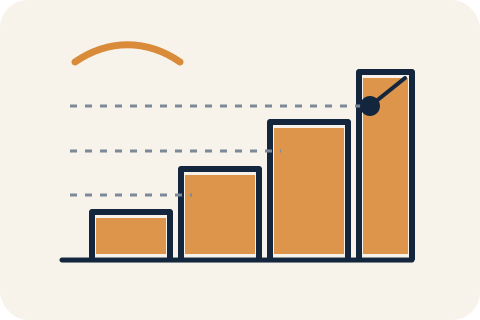
The marginal rate applies only to Jordan’s top layer of taxable income. The lower layers keep their lower rates, which is why the effective rate is smaller.
Change one input and watch the consequence
If annual income rises to $95,000 while the adjustment and deduction stay fixed:
Base case versus one changed input
If annual income rises to $95,000 while the adjustment and deduction stay fixed
Base case
Estimated federal income tax
$9,210.00One-input change
Alternative estimated tax
$11,410.00If annual income rises to $95,000 while the adjustment and deduction stay fixed
The extra income is evaluated through the same bracket stack; it does not retroactively reprice the earlier dollars.
Before you use the estimate
- Recreate the example only with records that support your own inputs.
- Keep the same filing status and tax year when comparing the published numbers.
- Change one material input at a time and read the full breakdown.
- Review the stated limitations before using the estimate.
Where this estimate stops
- This narrow example includes only ordinary taxable income and no credits, preferential-rate income, additional taxes, or return-specific rules.
- The fictional facts illustrate production logic and do not establish eligibility, filing treatment, or a recommended action for any reader.
Sources and references
Only the primary federal sources used for the rules discussed in this guide are listed here.
- Revenue Procedure 2025-32
Internal Revenue Service · The inflation-adjusted 2026 ordinary brackets, standard deductions, preferential-rate thresholds, and other indexed amounts used by the applicable calculation.
TaxArith provides illustrative 2026 U.S. federal tax estimates for general information. It is not tax, legal, financial, or investment advice and does not prepare or file a return. Results depend on the accuracy and completeness of the submitted facts.